
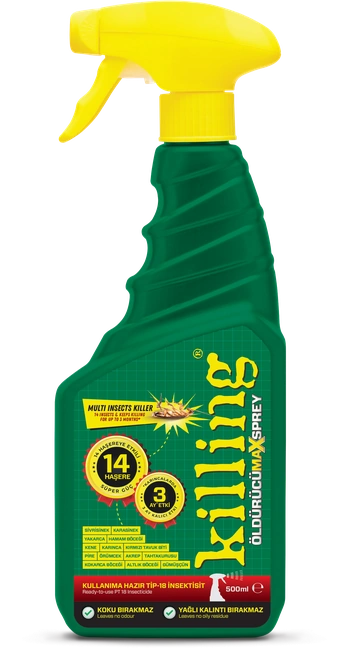
KILLING MAX SPRAY
FREQUENTLY ASKED
QUESTIONS.
Safety, correct application and checking the results.
01SAFETY AND SUITABILITY
01Is the product authorised by Türkiye’s Ministry of Health?
+
Killing Max Spray is a Type 18 biocidal product authorised by Türkiye’s Ministry of Health. Authorisation number: 2025/220; date: 4 November 2025.
02Can I use Killing Max in a home with babies or children?
+
Killing Max is used on surfaces in unoccupied indoor areas. Babies and children must not be present during application. Keep the product away from children, food and animal feed. Keep the area closed for 1 hour, wait for surfaces to dry, then ventilate for 1 hour. Do not use the area until all conditions have been met.
03How should I use it in a home with pets?
+
Remove pets before applying Killing Max. Do not apply to animals, food or water bowls, toys or surfaces animals contact directly. Keep the indoor area closed for 1 hour; once surfaces are dry, ventilate for 1 hour. Return animals only after these conditions have been met.
04Can I spray my cat or dog to treat fleas?
+
No. Killing Max must not be applied to animals. It is used on suitable surfaces nearby where fleas may be present. For fleas on an animal, use an appropriate product recommended by a vet.
RELATED PEST GUIDE ↗02PRODUCT, ACTION AND APPLICATION
05Which pests does Killing Max kill?
+
Killing Max is a ready-to-use insecticide spray effective against 14 pests: cockroaches, ants, bed bugs, fleas, mosquitoes, house flies, spiders, silverfish, ticks, scorpions, brown marmorated stink bugs, sand flies, red poultry mites and lesser mealworms. Apply to the surfaces specified on the label.
06How does Killing Max work?
+
Increased activity may be seen initially; this indicates that the product has started to take effect. Pest movement then begins to decrease, and the pests die within 24 hours.
07I sprayed an insect, but it did not die immediately. Does this mean the product is ineffective?
+
An insect not dying immediately does not, on its own, mean Killing Max is ineffective. Killing Max insecticide spray is applied to suitable surfaces, so contact with the treated surface is important. Increased activity may be seen initially; this indicates that the product has started to take effect. Pest movement then begins to decrease, and the pests die within 24 hours.
08Should Killing Max be sprayed on insects or surfaces?
+
Apply Killing Max to the surfaces specified on the label. Identify suitable places where the target pest travels, hides or rests. Hold the bottle upright and spray from a distance of approximately 40 cm. When pests come into contact with treated surfaces, the insecticide transfers onto their bodies.
09How long should the room remain closed after application?
+
Keep the indoor area treated with Killing Max closed for 1 hour. Wait for surfaces to dry, then ventilate for 1 hour. Drying time varies, so the total time is not necessarily just two hours. Treatment around the home for ticks is an exception to the requirement to keep the area closed.
03RESIDUAL EFFECT AND CLEANING
10Which pests does the residual effect of up to 3 months apply to?
+
Killing Max provides residual effect for up to 3 months against ants and up to 2 months against cockroaches. The 3-month period does not apply to all 14 pests. Treated surfaces must not be wiped or washed.
RELATED PEST GUIDE ↗11What does residual effect mean?
+
It means Killing Max continues to work on the treated surface, affecting pests that come into contact with it for up to 3 months for ants and up to 2 months for cockroaches. New pests may enter from outside; residual effect is not a physical barrier to entry.
12Does cleaning affect the residual effect?
+
Yes. Wiping or washing a surface treated with Killing Max ends its residual effect. To retain residual effect, do not wipe or wash treated surfaces. Do not treat food-contact surfaces or surfaces touched directly by people or animals in order to avoid cleaning them; choose suitable nearby surfaces.
04APPLICATION AREAS AND PRODUCT FEATURES
13Can I spray it on a bed for bed bugs?
+
Do not apply Killing Max directly to sheets, pillows, duvets, clothing or textiles that contact bare skin. For bed bugs, target suitable hard surfaces around the bed base or frame, behind the headboard, along skirting boards, in cracks and at hiding places.
RELATED PEST GUIDE ↗14Should I spray it into the air for mosquitoes?
+
No. Killing Max must not be sprayed indiscriminately into the air. Apply to suitable surfaces where mosquitoes land and rest, such as walls and areas around doors and windows.
RELATED PEST GUIDE ↗15Where should I apply it for ants?
+
Apply Killing Max to suitable surfaces along ant trails and at entry points, such as skirting boards, door and window edges, cracks and under cupboards. Do not apply to food-contact surfaces.
RELATED PEST GUIDE ↗16Can I use it in the kitchen?
+
Killing Max may be applied to suitable surfaces in an unoccupied kitchen: behind cupboards and appliances, under worktops, in cracks and along pest routes. Do not apply to exposed food, crockery or food preparation worktops. Follow the label’s drying and ventilation requirements.
17Does Killing Max have an odour?
+
An alcohol smell may be noticeable at the start of application; Killing Max leaves no odour after application. An absence of smell does not mean ventilation is unnecessary. Keep the area closed for 1 hour; once surfaces are dry, ventilate for 1 hour.
18Does it leave an oily residue?
+
Killing Max Spray leaves no oily residue. This does not mean treated surfaces can be touched before the drying and ventilation requirements have been met.
05MONITORING RESULTS AND DOSAGE
19Does Killing Max kill eggs too?
+
The current Killing Max Information and Application Guide states that the product does not affect eggs. Newly hatched pests may appear later. Before reapplying, check the amount and application interval specified on the label for the pest concerned.
20Is it normal to still see pests after treatment?
+
Increased activity may be seen initially; this indicates that the product has started to take effect. You may also see pests that have not come into contact with treated surfaces, newly hatched pests or new arrivals from outside. Check the areas treated, whether pests are likely to have contacted them and whether surfaces have been cleaned. Do not expect an entire infestation to end with one application.
21Do I need to apply it again every day?
+
Killing Max does not generally need to be reapplied daily. The label specifies an application interval of 3 months for ants and 2 months for cockroaches. These intervals do not apply to other pests. Check the official label information in the relevant guide and do not reapply more often than the label allows.
22Can I dilute Killing Max or add it to water for mopping?
+
No. Killing Max is ready to use and should be applied directly. Do not dilute it, add it to water or use it in water for mopping.
23Can I use it on plants or garden pests?
+
Do not apply Killing Max to plants or general garden pests. The label specifies surface application in unoccupied indoor areas, with additional use around the home for ticks. This exception does not authorise use as a plant protection product.
24How much product should I apply?
+
The official Killing Max label specifies a different application amount for each target pest. Do not use the same amount for every pest or estimate a number of sprays. Select your pest and check the official dose and application amount in the relevant Killing Max application guide.
CHOOSE YOUR PEST, CHECK THE APPLICATION AMOUNT ↗06PRODUCT AND TARGET SUITABILITY
25What is Killing Max?
+
Killing Max is a ready-to-use insecticide spray effective against 14 pests. It is a Type 18 biocidal insecticide. Apply to the surfaces specified on the label, never to people or animals.
26Is Killing Max an insect killer or pest control spray?
+
Yes. “Insect killer” and “pest control spray” are everyday descriptions of Killing Max’s product category. It is a Type 18 biocidal insecticide for the pests listed on its label, not a room aerosol or personal repellent.
27Can Killing Max be used as an ant killer?
+
Yes. Ants are among the pests listed on the Killing Max Spray label. Apply to suitable surfaces along routes and at entry points. For residual effect of up to 3 months against ants, do not wipe or wash treated surfaces.
RELATED PEST GUIDE ↗28Can Killing Max be used as a cockroach killer?
+
Yes. Cockroaches are among the pests listed on the Killing Max Spray label. Apply to suitable surfaces at hiding places and along routes. For residual effect of up to 2 months against cockroaches, do not wipe or wash treated surfaces.
RELATED PEST GUIDE ↗29Can Killing Max be used against bed bugs?
+
Yes. Bed bugs are among the pests listed on the Killing Max Spray label. Target suitable hiding and travel surfaces. Do not apply to sheets, pillows or textiles that contact bare skin. Do not extend the residual durations for ants and cockroaches to bed bugs.
RELATED PEST GUIDE ↗30Can Killing Max be used as a flea killer?
+
Yes. Fleas are among the pests listed on the Killing Max Spray label. Apply to suitable nearby surfaces where fleas may be present, never to cats, dogs or other animals. Consult a vet for fleas on an animal.
RELATED PEST GUIDE ↗